Borrow Before You Buy: Running a Postal Switch Library Without Losing the Lot
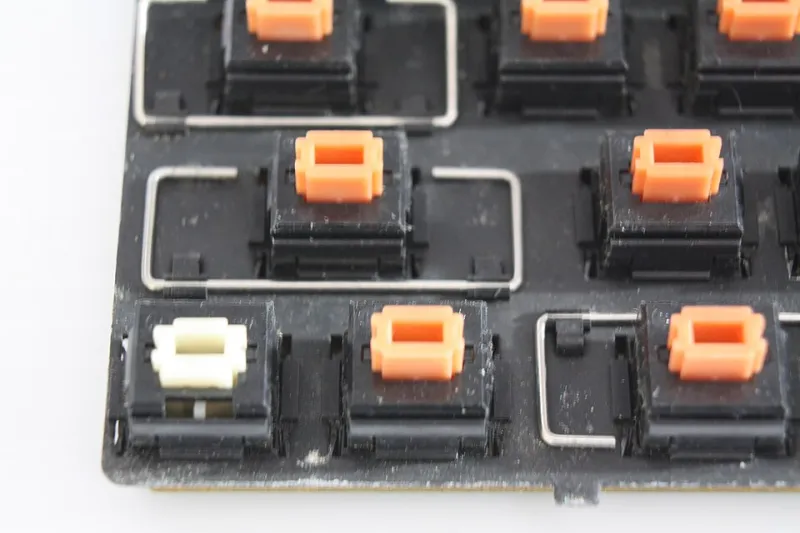
Photo: snuci, Public domain, via Wikimedia Commons
Every builder has done it. Read four reviews, watched two sound tests recorded through a phone, and bought ninety switches on the strength of it. Then the parcel arrives, you press one into a tester, and you know within eight seconds that you have made a £65 mistake.
Switch samples exist for exactly this reason, but a proper sample set costs as much as the switches. The obvious answer is to share — a small library, run by post, where members try a box of switches and send it on. It is cheap, it is sociable, and it will fall apart within a year unless you are slightly ruthless about the rules.
The shape of the thing
Keep it small. Ten to fifteen members is the ceiling for a single circulating box; more than that and the wait between turns becomes long enough that people forget they joined. One box, one queue, one person holding the manifest at any given time.
What goes in the box: twelve to eighteen switch types, labelled, with enough units that someone can fill a small macropad or at least press each one properly across a few days. Three of each is the minimum; five is better. Cover the ground — a couple of heavy tactiles, two medium tactiles, a silent tactile, four linears across the weight range, one long-pole linear, two silents, and one clicky for the person who insists.
Do not include lubed switches. Lubed switches pick up dust, arrive feeling different from how they left, and start arguments about whose fault it is. Factory-stock only, and say so in the rules.
The social contract, in six rules
- You get the box for seven days from the delivery scan.
- You send it on within two working days of your turn ending, using the agreed service.
- You replace anything you break, at cost, no discussion needed.
- No lubing, filming, swapping springs or otherwise improving the samples.
- Photograph the box as it arrives.
- If you go quiet for fourteen days, the deposit is forfeit and the box comes home.
Rule six is unpleasant and it is the reason the library still exists in year two. Someone always goes quiet. It is rarely malice — usually a house move or a bad month — but a library without an exit clause becomes a library that has quietly disappeared into someone's spare room.
Deposits that actually work
A refundable deposit of £25 to £40, held by whoever runs the library, is enough to concentrate minds without pricing anyone out. Take it by bank transfer, record it, refund it when the box is confirmed delivered onward. Do not use a payment method with fees you cannot absorb, and do not call it a membership fee unless you intend to keep it.
Alternative model for tighter groups: no deposit, but every member agrees to replace the full box value if it stops with them. This works beautifully among people who already know each other and fails completely among strangers. Be honest about which group you are in.
Packaging that survives the postal system
A box of loose switches is a bag of small hard objects, and the postal system treats it accordingly. Small switches will find any gap.
- Use a rigid double-wall box, roughly shoebox sized, not a padded envelope.
- Put each switch type in its own small zip bag, labelled with a printed sticker. Handwriting fades and smudges; printed labels survive.
- Individually bagged switches are better than a compartment box, which will pop open and redistribute everything across the bottom of the parcel.
- Add a printed manifest inside the lid — a paper list of contents and the current queue. It is faster than a spreadsheet when you are standing at a counter.
- Seal with tape across every seam, and write FRAGILE in marker. It does nothing, officially. It helps, unofficially.
Weigh the finished box once, write the weight on the lid, and use that number every time. Royal Mail second class or Tracked 48 is the sensible default for a small parcel in this weight class; it is cheap, it is tracked enough to settle arguments, and it does not require anyone to install an app. Print labels at home if you can — it saves a queue and it gives you a timestamp.
Record keeping that takes four minutes
A single shared spreadsheet, one row per turn: member, date received, date sent, tracking number, condition on arrival, notes. Add a photo folder for the arrival shots. That is the entire system. Anything more elaborate will be abandoned by March.
Check the tracking yourself rather than waiting to be told. The person running the library should be the one who notices a box has stalled, not the member three places back in the queue, who will simply assume it is lost forever and buy their own switches out of despair.
The awkward parts, decided in advance
What happens when a sample goes missing? Nothing, if it is one switch — that is the cost of doing business. What if a whole bag of five disappears? Replacement at cost, quietly, no shame attached.
What about hygiene? Switches get handled by strangers. Wipe each sample with isopropyl on a cloth before it goes back in the bag, keep the box out of kitchens, and skip anyone who is clearly sending on a box that has been in a workshop. A small pack of alcohol wipes in the box costs almost nothing and heads off the entire conversation.
And what about the person who wants to join, borrow, and then vanish? Deposits handle that. What about the person who joins, borrows, and then buys eighty of everything they tried? That is not a problem — that is the library working exactly as intended, and it is why the manufacturers should be quietly grateful.