Buy Once, Fix Often: A 2026 UK Keyboard Repairability Scorecard
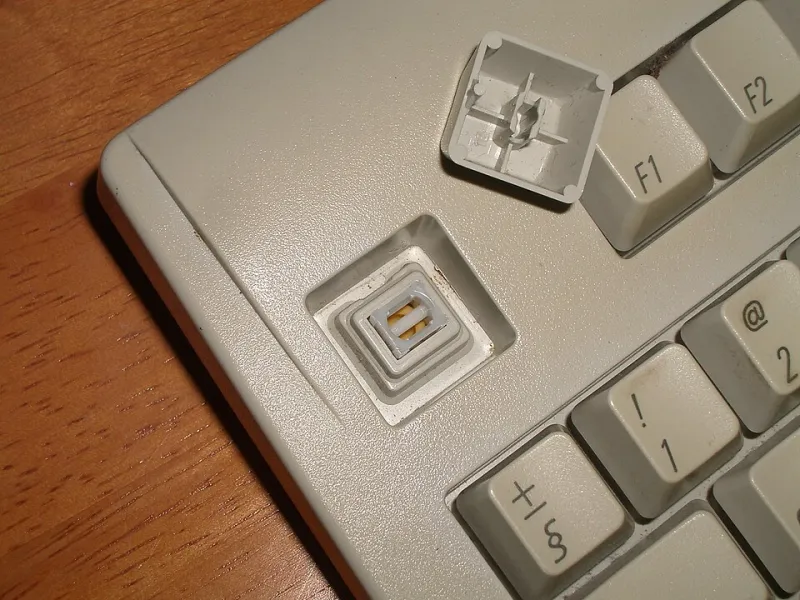
Photo: Daniel beardsmore, Public domain, via Wikimedia Commons
Most keyboard buying advice asks the same question: does it feel good on day one? Fair enough. But an enthusiast keyboard is a small mechanical ecosystem, and the interesting question is what happens when a hot-swap socket dies, a stabiliser wire gets bent, or the USB-C daughterboard starts acting up after eighteen months of daily use.
That is where the spare-parts handshake comes in. Not a secret society, not a brand club — just a short, sensible exchange between buyer and seller about whether the thing can be fixed. In the UK, where postage is rarely free and customs paperwork can turn a cheap spare into a mild administrative event, fixability is part of the value.
Why fixability belongs in the buying decision
A keyboard with standard fasteners, a replaceable USB port and a current revision of its PCB is a long-term desk companion. A sealed case with a glued battery and a board that only talks to one vendor app is a future skip run with extra steps.
This is not about demanding a five-year parts promise from every seller. It is about knowing which parts are consumables and which are effectively permanent. Switches wear. Stabiliser wires get bent during cleaning. Foam compresses. USB ports take a beating. If none of those can be replaced, the keyboard is more disposable than it looks.
The five-minute listing audit
Start with the product page. A good listing tells you what the board is made of and what happens when it breaks. Look for:
- The PCB name and revision, especially if the case or plate has been revised.
- Plate material, mount type and stabiliser format.
- Firmware support: QMK, VIA, ZMK or a documented vendor tool.
- Whether the USB-C port sits on a separate daughterboard.
- Case screw type and whether the case is designed to be opened.
- For wireless boards, whether the battery is a standard connector and a replaceable cell.
- A UK returns address or at least a named UK distributor.
If the listing cannot answer those questions, that is not automatically a no. It is a prompt to ask.
Questions worth sending before you pay
Keep the message short and specific. Sellers respond better to one clear email than to a dissertation on e-waste.
- If a hot-swap socket fails, can I buy a replacement PCB separately? What is the price and typical lead time?
- Are stabilisers, plate, foam and gasket strips available as spares?
- Is the USB-C port on a daughterboard, and can I buy that part on its own?
- Which firmware does it run, and can I flash it without your app?
- If it is wireless, is the battery a standard replaceable cell?
- What is your UK return address, and who pays postage for a faulty kit?
- Are the spare parts the same revision as the board you are selling today?
A seller who answers those plainly is giving you something more useful than a spec sheet: a maintenance path.
Red flags in product listings
Some phrases should make you pause. “Sealed for acoustic purity” can mean “not designed to be opened”. “Warranty void if disassembled” is understandable on a finished retail board, but it sits awkwardly with enthusiast repairability. “Firmware managed through our companion app” is fine until the app stops being updated.
Other warning signs: no mention of PCB revisions, spare parts shown in photos but not listed for sale, group-buy pages with no after-sales plan, and ISO-UK layouts advertised as “coming soon” while the buy page stays open. None of these are automatic disqualifications, but they should change how much you are willing to spend.
The scorecard: ten points at checkout
Use this as a quick tally. One point for each yes. It is deliberately blunt.
| Check | Point |
|---|---|
| PCB is sold separately or its design files are available | 1 |
| Plate, stabilisers and common wear parts are listed as spares | 1 |
| USB-C port is on a replaceable daughterboard | 1 |
| Case uses standard, replaceable fasteners | 1 |
| Firmware is open or can be flashed offline | 1 |
| Wireless battery is a standard replaceable cell | 1 |
| Seller has a UK returns address or UK distributor | 1 |
| Spare parts match the current revision | 1 |
| Warranty and disassembly policy are stated clearly | 1 |
| The layout and parts you want are actually in stock | 1 |
A score of eight to ten is a comfortable buy. Five to seven is a board worth questioning before you commit. Four or below is a board you should treat as disposable — which is fine if the price reflects that, and less fine if it does not.
What UK consumer rights actually cover
The Consumer Rights Act 2015 says goods must be as described, fit for purpose and of satisfactory quality. If something fails early, you have a short-term right to reject within 30 days, then rights to repair or replacement, and ultimately a price reduction or final rejection. In the first six months, the burden is generally on the retailer to show the fault was not present at purchase.
Online orders also come with cancellation rights under the Consumer Contracts Regulations 2013, though custom-made or personalised items can be exempt. Group buys and overseas sellers can complicate all of this. If you pay by credit card and the cash price is over £100, Section 75 may give you extra protection. Keep invoices, listing screenshots and email threads.
A repairable keyboard is not a substitute for your statutory rights. It just makes them easier to use when something goes wrong.
The handshake test
Before checkout, imagine the keyboard two years from now with one dead socket and a slightly mushy spacebar. Can you buy the parts? Can you open the case? Can you flash the firmware? Can you post it to a UK address without a customs form?
If the answer is yes, you are not just buying a keyboard. You are buying a reasonable chance of keeping it on the desk. That is the spare-parts handshake, and it is worth more than another glossy hero image.